Batch Reactor vs Flow Reactor: Key Differences and Applications
Every industrial chemical process begins with a fundamental decision — how should the reaction be carried out? For decades, the batch reactor has been the default answer. It is familiar, flexible, and widely understood. But as industries scale, tighten quality standards, and chase efficiency, a new question is being asked more often: is a flow reactor the smarter choice?
Understanding both systems is not just academic. It directly impacts yield, safety, cost, and scalability.
What Is a Batch Reactor?
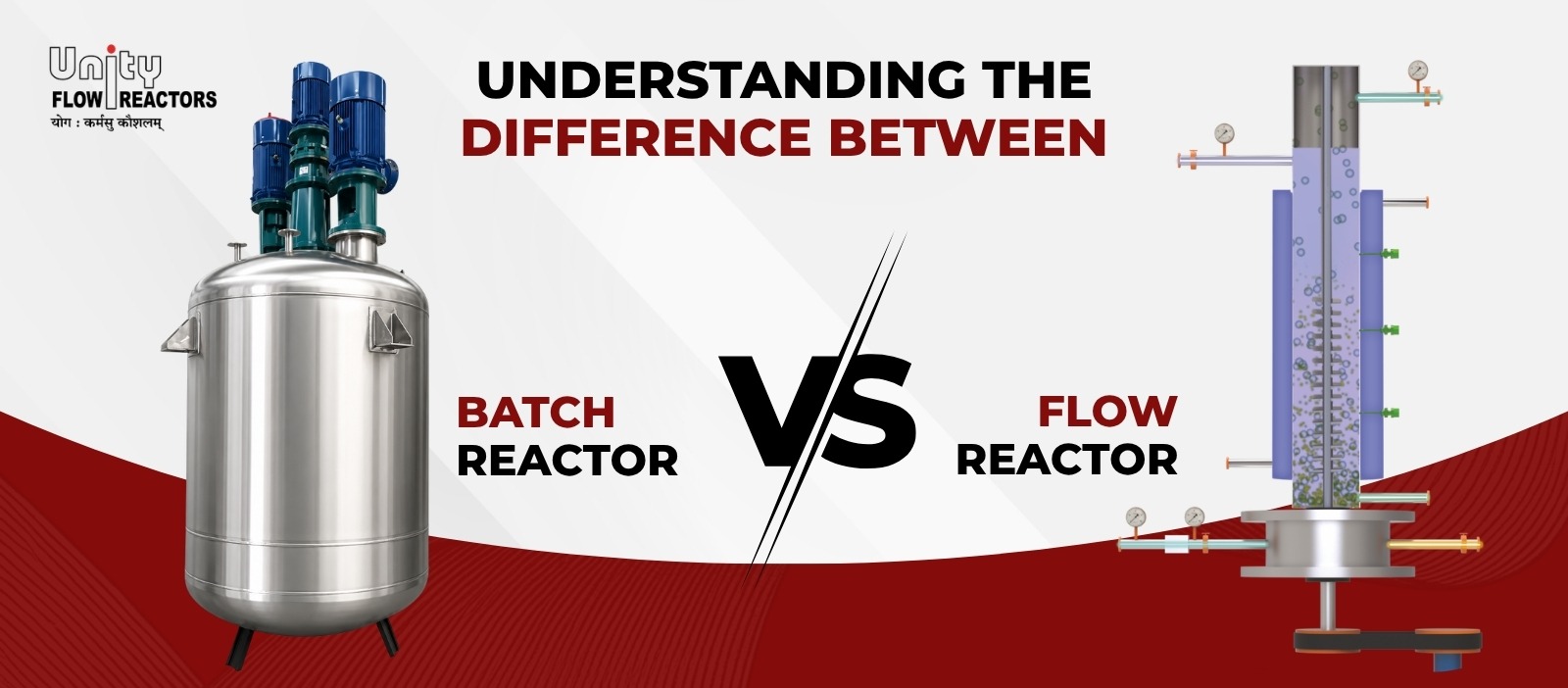
A batch reactor is a closed vessel where all reactants are charged at once. The reaction proceeds over a set period. Once complete, the product is removed, the vessel is cleaned, and the next cycle begins.
It is a time-tested approach. Pharmaceutical development, specialty chemicals, and small-scale production have relied on the batch reactor for generations. The system allows easy monitoring and straightforward process control. Product changeovers are simple.
However, limitations exist. Heat management becomes difficult at scale. Reaction consistency can vary from batch to batch. Cleaning time reduces overall productivity. Hazardous intermediates are present in large quantities at once. These are not minor inconveniences at an industrial scale. They are real operational risks.
What Is a Flow Reactor?
A flow reactor operates differently. Reactants are continuously fed into the system. Reaction occurs as the material moves through a defined channel, tube, or chamber. The product exits in a continuous stream.
This design changes everything. Heat transfer is precise because the reaction zone is smaller and more controlled. Mixing is uniform. Residence time is consistent. Hazardous reactions are safer because only a small volume of reactive material exists at any given moment.
Flow chemistry is not new. But the engineering sophistication now available from dedicated flow reactor manufacturers has brought it into mainstream industrial use across chemical, pharmaceutical, agrochemical, and fine chemical sectors.
Key Differences at a Glance
| Parameter | Batch Reactor | Flow Reactor |
|---|---|---|
|
Scale and Flexibility |
Easier to set up for small volumes and variable products |
Easier to set up for small volumes and variable products |
|
Heat and Mass Transfer |
Heat management becomes difficult at scale; less surface area control |
Superior heat transfer due to high surface area to volume ratio; tighter temperature control; exothermic reactions are safer to manage |
|
Safety Profile |
A large volume of hazardous material is present in the reaction zone at once |
Significantly reduced inventory of hazardous material; a major advantage for toxic intermediates or explosive compounds |
|
Consistency and Quality |
Introduces variability in residence time and mixing conditions across cycles |
Delivers consistent residence time and mixing conditions, critical for regulated industries like pharmaceuticals |
|
Downtime |
Requires cleaning, charging, and discharging between every cycle |
Operates continuously without interruptions; improves overall equipment effectiveness |
When to Choose Which
The batch reactor remains the right tool for certain jobs. Small volumes, multiple product types, reactions requiring extended hold times, or processes under development all benefit from the flexibility of batch processing.
The flow reactor becomes the preferred choice when throughput must be high, quality must be consistent, reactions are hazardous, or process intensification is a priority. Modern reactor manufacturers have developed modular flow systems that can be scaled from lab pilot to full production without redesigning the core chemistry.
Industries making this shift include API synthesis, nitration reactions, polymerization, photochemistry, and electrochemistry, all of which benefit directly from the precision and safety that continuous flow offers.
The Industry Is Moving Forward
The global trend is clear. More reactor manufacturers are investing in flow technology. More chemical and pharmaceutical companies are transitioning mature batch processes to continuous flow to gain competitive efficiency and regulatory compliance.
The question is no longer whether flow reactors work. The question is which design fits the specific reaction chemistry and production requirement.
Make the Right Reactor Decision with Unity Flow Reactors
If your process is approaching scale, or if safety and consistency are becoming harder to manage in batch, it may be time to explore continuous flow. Unity Flow Reactors, based in Vadodara with over 35 years of engineering experience, designs and delivers customized flow reactor solutions for chemical and pharmaceutical industries across India. From CSTUR and Fluidized Bed Reactors to Plate Type and Pinched Tube systems, every solution is engineered to your specific process requirement. Connect with the Unity Flow Reactors team today and find out how the right reactor design can transform your production outcomes.
A batch reactor processes all reactants in a single closed cycle, while a flow reactor runs continuously with reactants flowing through the system. Flow reactors offer better heat control, consistency, and safety compared to traditional batch processing.
The pharmaceutical, fine chemical, agrochemical, and speciality chemical industries benefit significantly. Flow reactors are especially valuable for hazardous reactions, API synthesis, and processes that demand tight temperature control and high repeatability at the production scale.
Yes. Many mature batch processes are successfully transitioned to continuous flow without changing the core chemistry. Experienced flow reactor manufacturers assess reaction parameters and design systems that replicate and often improve on batch performance.
Generally not. Because of the small size the metal cost is much less but instrumentation and precision pumps partially offset the benefit. However, lower downtime, better yields, reduced waste, and improved safety typically result in a strong return on investment, particularly for high-volume or regulated production environments.