Why Industries Are Shifting from Batch Processing to Continuous Flow Technology
The global chemical and pharmaceutical manufacturing landscape is experiencing an unprecedented technical evolution. For decades, production plants relied entirely on traditional stop-and-start methods to process chemicals. However, escalating operational costs and stricter regulatory mandates are forcing a major structural change. A modern continuous flow reactor is now replacing ageing infrastructure across competitive markets. Forward-thinking facilities are abandoning the single-pot method to embrace Continuous Flow Technology because it delivers higher product purity and drastically reduces manufacturing cycle times.
Understanding the core operational differences is vital for plant managers looking to optimise capital expenditures. When analysing the difference between batch and continuous process frameworks, the most obvious contrast is asset utilisation. Batch processing requires extensive downtime for filling, heating, cooling, and cleaning vessels. This structural inefficiency creates costly bottlenecks. Conversely, a continuous processing system allows raw materials to be fed uninterruptedly into a temperature-controlled fluid path, creating a steady stream of finished product.
The Operational Merits of Continuous Flow Technology
The economic and technical advantages of moving away from traditional types of reactors toward continuous systems are clear. By managing chemistry in motion, plants can shrink their physical production footprint by up to 70% while maintaining or exceeding their daily output targets.
- Superior Heat Dissipation: Small internal channels provide an exceptionally high surface-area-to-volume ratio for rapid temperature adjustments.
- Inherent Safety Profiles: Because only a few millilitres or litres of chemical are active at any single moment, the danger of an unmanageable thermal runaway is eliminated.
- Sustained Mass Transfer: Engineered static or dynamic mixing elements ensure that reagents maintain perfect molecular contact throughout the fluid pathway.
This control is particularly valuable for industries handling dangerous Nitrations, hazardous Halogenations, or rapid organometallic synthesis. When comparing a flow reactor to a conventional tank, the continuous framework yields higher quality by ensuring that every molecule experiences the same residence time and thermal history.
Tailored Process Intensification with Unity Flow Reactors
Transitioning your production line requires more than buying standard off-the-shelf hardware. A successful migration requires a deep understanding of your chemical roadmap and fluid characteristics. As an engineering authority with over thirty-five years of experience, Unity Flow Reactors specialises in designing customised continuous systems that bridge the gap.
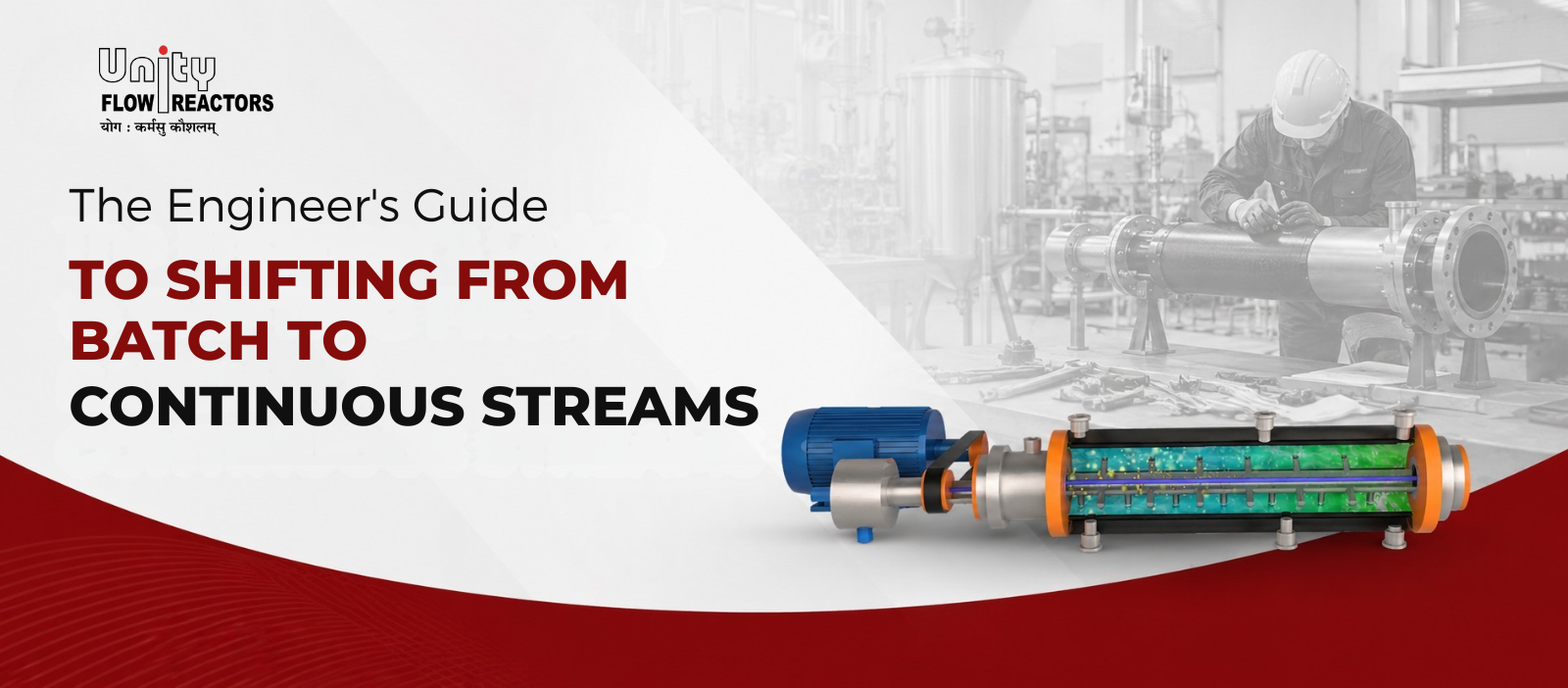
We recognise that issues such as solid handling, high viscosities, and highly corrosive intermediates require customized engineering solutions rather than generic catalogue items. Our proprietary Continuous Stirred Tubular Reactor or CSTUR technology is engineered specifically to prevent clogging and settling in multi-phase reactions. We analyse your specific kinetics, thermodynamic bounds, and material sensitivities to build a robust, high-performance manufacturing asset that integrates seamlessly with your plant infrastructure.
The industrial transition toward Continuous Flow Technology is an operational necessity for facilities aiming to secure market leadership. Continuous processing provides the automated control, safety, and product consistency that conventional batch vessels simply cannot replicate. Mitigating operational risks and achieving predictable, linear scaling requires working with an engineering partner who understands application-specific customisation.
Unity Flow Reactors delivers the fabrication quality, technical depth, and validation support required to transform your manufacturing efficiency. Our customised reactor designs are built to solve your toughest processing bottlenecks while ensuring absolute regulatory compliance. Elevate your plant capabilities, minimise waste, and secure consistent production quality by collaborating with our engineering specialists.
The main benefit is steady-state operation. This eliminates batch-to-batch variations by ensuring that every molecule experiences the same temperature, pressure, and residence time during the reaction.
A flow reactor holds a minimal volume of active chemicals at any moment. If an emergency occurs, the small volume allows for immediate quenching or cooling, reducing the risk of a runaway.
Yes. While standard narrow tubes might struggle, customised systems like the Unity CSTUR utilise active internal mechanical agitation to handle higher viscosities and prevent solids from settling.
No. Unlike a batch setup that requires a complete mechanical redesign, a continuous process scales up predictably by lengthening the run time or running parallel reactor lines.
We provide application-specific engineering. Our specialists design and fabricate custom built continuous systems that match your exact chemical kinetics, metallurgical needs, and automated control requirements.