Flow Reactors 101: Understanding Continuous Flow Chemistry and Its Industrial Impact
- May 20, 2026
Traditional batch reactors have served chemical manufacturing for decades, but they carry inherent limitations. Temperature hotspots can develop during exothermic reactions, posing safety risks and leading to batch failures. Scaling-sensitive chemistries or handling hazardous materials present ongoing challenges. The flow reactors represent a fundamental shift, enabling continuous operation in which reactants enter one end, and products exit the other in a steady stream. This approach transforms reaction control, safety, and scalability, reshaping modern chemical processing.
The Fundamentals: Batch vs. Continuous Flow
The Batch Reactor: The Single Pot Approach
Think of a batch reactor like cooking soup. You add all ingredients to the pot at the start, heat and stir for a specific time, then remove the finished product. In chemical terms, reactants are charged into a vessel, the reaction proceeds to completion, and the product is discharged before the next batch begins.
This approach works well for many applications, but it has built-in challenges. Temperature control becomes difficult as reaction volumes increase. Hotspots can develop in poorly mixed zones. Scaling up from laboratory to production often requires significant process adjustments. Each batch takes time to charge, react, discharge, and clean, creating operational inefficiencies.
The Flow Reactor: The Continuous Stream Approach
A flow reactor operates more like a river. Water continuously flows from source to mouth, maintaining constant movement. Similarly, in a continuous-flow reactor, reactants are continuously pumped into the system while products are continuously removed.
This creates what engineers call steady state operation. Once the system reaches equilibrium, conditions remain constant throughout the reactor. Temperature, pressure, concentration, and residence time stay uniform. Each reactant molecule experiences identical processing conditions, resulting in remarkably consistent product quality.
The analogy of a conveyor belt also applies. Material moves through the reactor at a controlled rate, spending a defined amount of time in the reaction zone before emerging as product.
Inside a Flow Reactor: How They Work
Core Mechanics
Three principles define flow reactor operation:
Chemical Manufacturing Applications:
Continuous Flow
Reactants enter, and products exit in an uninterrupted stream. There are no discrete batches. The process runs continuously for hours, days, or even weeks without stopping.
Small Reaction Volume
At any given moment, only a small amount of material undergoes reaction. This is fundamentally different from batch processing, where the entire charge reacts simultaneously. Smaller volumes mean easier thermal management and reduced safety risks.
Precise Control
Temperature, pressure, and mixing are tightly controlled throughout the reaction zone. The high surface-area-to-volume ratio in flow systems allows rapid heat addition or removal. Uniform flow patterns eliminate mixing variations that plague batch reactors.
Types of Flow Reactors
- Plug Flow Reactor (PFR): The plug flow reactor consists of a tubular structure where reactants move in a “plug-like” fashion with minimal backmixing. Imagine pushing a colored dye through a clear tube filled with water. The dye plug moves forward without dispersing backwards. This ensures every molecule spends the same time in the reactor, called residence time.
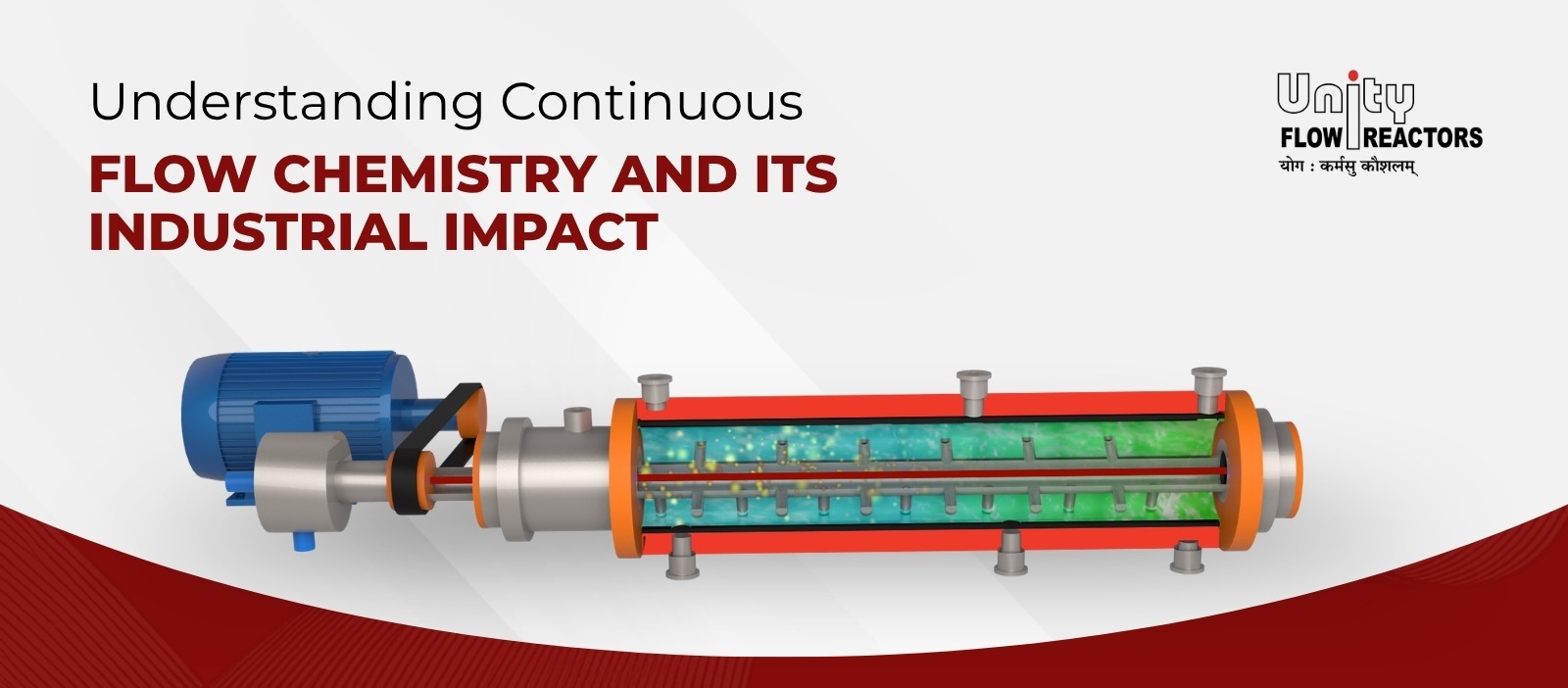
- Stirred Tubular Flow Reactor: These are tubular reactors with varying internal designs and usually fitted with high speed mechanical stirrers. The stirrer speeds may range from 1000 RPM to as high as 9000 RPM depending upon the mixing demands. The length and diameter of the tubular flow reactor determine residence time and reaction conditions.
- Microreactors: These specialised flow reactors use extremely small channels, sometimes measured in micrometres. The small dimensions provide exceptional heat-transfer and mixing control, ideal for highly exothermic or fast reactions.
Why the Shift? Key Advantages of Flow Reactors
- Enhanced Safety:
Small reaction volumes drastically reduce risk. While a 5,000-litre batch reactor carries a significant hazard, a continuous flow reactor often holds only 500 ml at any moment. This containment makes exothermic reactions far more manageable. - Superior Heat and Mass Transfer:
The high surface-area-to-volume ratio enables rapid heating and cooling. This thermal control prevents the temperature excursions common in large vessels. Additionally, controlled flow patterns ensure uniform mixing and eliminate the dead zones found in a traditional batch reactor. - Better Product Consistency:
Every molecule experiences identical reaction times and temperature profiles. This uniform residence time translates to higher purity and fewer byproducts. For industries requiring strict validation, the elimination of batch-to-batch variation is transformative. - Predictable Scalability:
Scaling up a batch reactor often requires extensive re-optimisation due to changes in heat-transfer dynamics. In contrast, a flow reactor scales by simply running longer or adding parallel units, making the transition from lab to production much faster.
Flow reactors scale differently. One approach is “numbering up”, where multiple identical flow reactors run in parallel. Another is simply extending operating time. A flow reactor producing 100 kilogram per hour can produce 2400 kilograms by running 24 hours instead of increasing the reactor size. This makes scale-up more predictable and less risky.
- Automation and Efficiency
Continuous operation reduces downtime between batches. Resources are utilized more efficiently. Many flow reactor systems can run with minimal operator intervention once properly commissioned.
Real World Impact: Where Flow Reactors Shine
Flow reactors are transformative for pharmaceutical API synthesis and specialty chemicals, enabling the safe handling of hazardous intermediates and toxic compounds. By minimizing active inventory and optimizing stereochemical control, these systems make dangerous, high-energy reactions feasible. Industries such as agrochemicals now leverage flow technology for processes once considered too risky for batch production.
The Future is Flow
The shift from batch reactor limitations to the precision and safety of continuous-flow reactor technology represents more than an incremental improvement. It enables chemistry that was previously impractical or impossible at an industrial scale.
For beginners exploring this field, remember these key takeaways: Flow reactors offer safer operation through smaller reaction volumes, more precise control through better heat and mass transfer, and more consistent products through uniform residence time. Whether considering a plug-flow reactor for a specific synthesis or exploring stirred tubular-flow reactor options for continuous production, the advantages are substantial.
As chemical manufacturing continues to evolve toward process intensification, the adoption of flow chemistry will accelerate. For those wondering whether continuous-flow technology could benefit specific processes, consulting experienced Flow reactor manufacturers like Unity Flow Reactors can provide valuable guidance. The future of chemical processing is increasingly continuous, increasingly controlled, and increasingly flow-based.
A batch reactor processes materials in discrete batches where all reactants are added at once, the reaction occurs, and then the product is removed. A flow reactor operates continuously, with reactants entering and products exiting, maintaining steady-state conditions. This fundamental difference significantly affects safety, control, consistency, and scalability.
Continuous flow reactors offer enhanced safety through smaller reaction volumes, superior heat and mass transfer from high surface area ratios, better product consistency through uniform residence time, predictable scalability via numbering up, and operational efficiency through continuous processing. These advantages make flow reactors ideal for exothermic, hazardous, or precision required reactions.
A plug flow reactor is a tubular system where reactants move in a plug like fashion with minimal back-mixing. Every molecule spends the same time in the reactor, ensuring uniform processing conditions. The tubular structure provides controlled flow patterns and consistent residence time, making it ideal for applications requiring precise reaction control.
Flow reactors are widely used in pharmaceutical API synthesis, specialty chemical production, agrochemical manufacturing, and fine chemical processes. They excel in applications involving hazardous intermediates, highly exothermic reactions, products requiring high purity, or processes needing precise stereochemical control where batch reactor limitations create safety or quality challenges.